

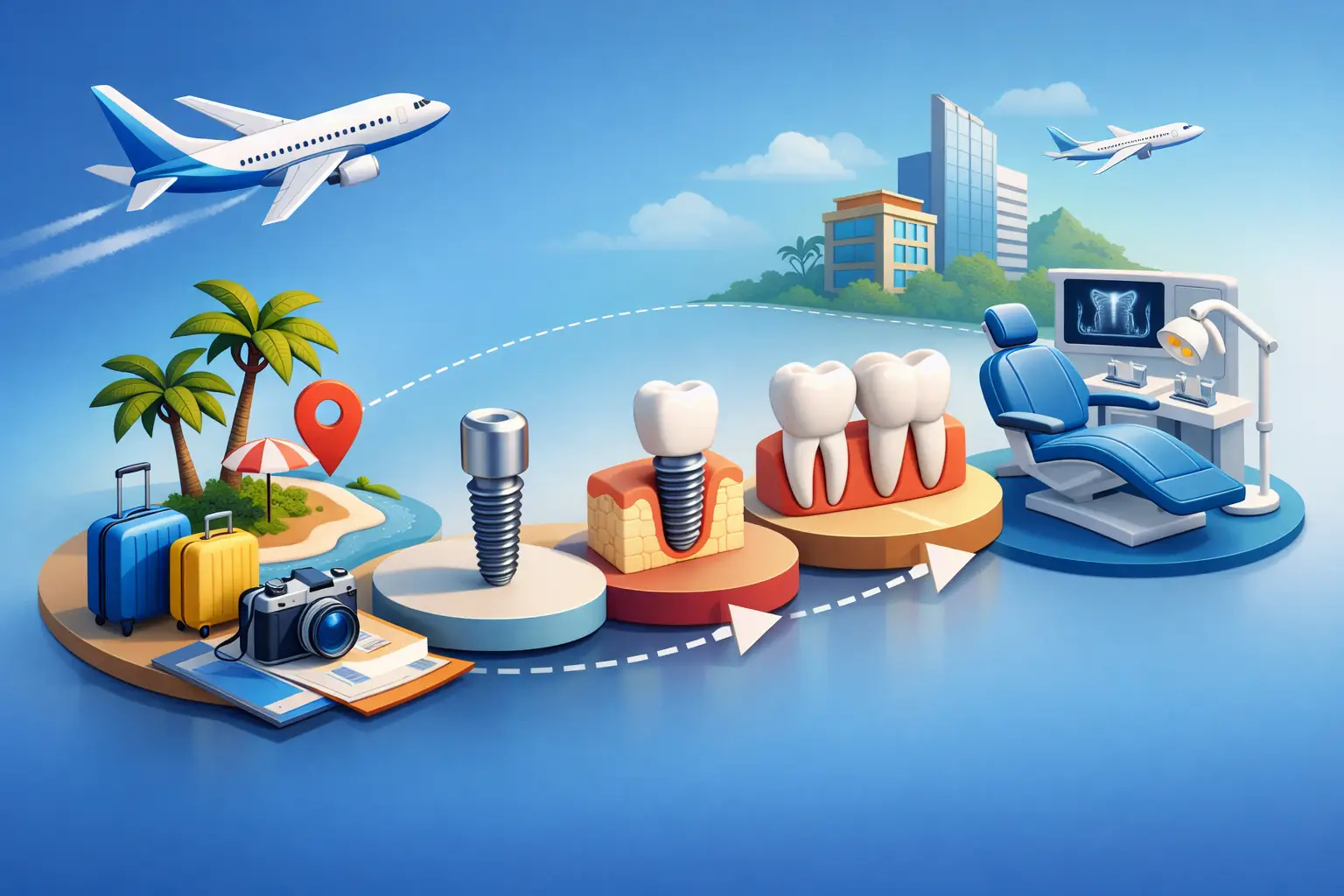
Travel Timeline for Dental Implants Explained
15 July 2026A dental implant is not a treatment to squeeze between a Friday flight and a Sunday return. The right travel timeline for dental implants protects your comfort, gives the clinical team time to assess healing, and helps you return home with clear next steps rather than unnecessary uncertainty. For patients travelling from the UK to Turkey, the timeline will depend on your bone health, the number of implants needed, whether teeth require extraction, and the type of final restoration planned.
At Dentaglobal, treatment planning begins before you travel. Digital records, photographs and X-rays can help the team prepare an initial view of your needs, but your final plan should always be based on a clinical examination and 3D imaging in the clinic. This is how a realistic travel schedule is created.
Your travel timeline for dental implants starts before booking
Before arranging flights, share recent dental X-rays where available, along with clear photographs, your medical history and information about any medicines you take. Conditions such as uncontrolled diabetes, active gum disease, smoking, blood-thinning medication or a history of radiotherapy may affect the treatment sequence and healing period. They do not automatically rule out implants, but they need careful clinical consideration.
An online consultation can explain likely options, estimated appointment length and the expected number of visits. It cannot replace an in-person assessment. A tooth that appears suitable for immediate implant placement on an X-ray may reveal infection, limited bone volume or a gum issue when examined properly.
It is sensible to keep your travel plans flexible until the proposed treatment schedule is confirmed. Booking a return flight for the same day as surgery is not advisable. Allow time for treatment, a post-operative review where required, and a calmer journey home.
The typical timeline for one or several implants
For many patients, implant treatment happens in phases. The implant itself is a small titanium post placed into the jawbone. It then needs time to integrate with the bone before it can reliably support a final crown, bridge or full-arch restoration.
Visit one: assessment, preparation and implant placement
A first visit commonly lasts between three and seven days, depending on the complexity of treatment. During this stay, the dental team can complete examinations, 3D CBCT imaging, hygiene or periodontal treatment where necessary, and any tooth extractions required before implant surgery.
If the site is suitable, the implant may be placed during the same trip. Some patients also receive a temporary tooth or temporary bridge, particularly where appearance matters in the smile zone. A temporary restoration is designed to support daily confidence while healing takes place. It is not always appropriate to place one immediately, especially if it would place too much pressure on a newly placed implant.
Mild swelling, tenderness and bruising are common after surgery. These effects usually peak during the first few days, which is why it is better to plan a relaxed itinerary rather than a sightseeing schedule. Soft foods, good oral hygiene and the prescribed post-operative instructions all matter during this period.
For straightforward cases, staying for several days after surgery allows time for an initial review. If extractions, bone grafting or more extensive surgery are involved, the clinic may recommend a longer stay or a more cautious plan.
Healing at home: usually three to six months
After placement, the jawbone needs time to heal around the implant. This process is called osseointegration. In the lower jaw, healing is often around three to four months; in the upper jaw, it can be longer because the bone is frequently less dense. Where bone grafting has been needed, healing may extend beyond six months.
During this period, you can normally return to work and everyday life once the immediate post-operative recovery has passed. However, you should avoid treating the implant as fully finished. Do not bite hard foods on a temporary restoration, skip hygiene routines or delay reporting unusual pain, swelling, looseness or discharge.
International patients should remain in contact with their clinic during healing. Clear photographs, video consultations and any requested local X-rays can help the treating team assess progress and advise on the timing of the next visit. If an urgent problem develops, seek care locally without waiting for your planned return trip.
Visit two: final teeth and bite adjustment
Once healing is confirmed, a second visit is usually arranged for the final restoration. This visit often takes five to eight days, allowing for digital scans, shade selection, design review, laboratory production and fitting of the final crown, bridge or implant-supported teeth.
The final stage is about more than attaching a tooth. The dentist checks the bite, gum contours, speech and appearance, then makes adjustments so the restoration feels natural and distributes chewing forces appropriately. A well-made crown should complement your smile, but it should also be easy to clean and stable under daily use.
When the schedule is shorter
Some implant journeys can be completed more quickly, but a short timeline is not automatically a better one. Immediate implants may be possible when a tooth is extracted and an implant can be placed at the same appointment. In selected cases, an immediate temporary tooth can also be fitted. This depends on bone quality, infection levels, bite forces, gum condition and the ability to achieve good implant stability.
Full-arch procedures such as All-on-4 or All-on-6 can often provide fixed temporary teeth within a short first visit. This can be life-changing for people with failing or missing teeth, but the temporary bridge still requires a controlled diet while healing takes place. The definitive bridge is normally fitted after the implants have integrated, often several months later.
At the other end of the scale, a staged approach can be the safest choice. If a tooth was removed previously, the socket may need to heal before implant placement. If bone volume is limited, grafting or sinus lifting may be recommended before the implant can be placed. These steps add time, but they can improve the foundation for a long-lasting result.
Flying, accommodation and practical planning
Most patients can fly after routine implant surgery, but the timing should be agreed with the dentist. It is generally wise to avoid flying immediately after surgery, particularly after sinus-related procedures or more complex grafting. Cabin pressure changes are not usually a concern after a straightforward implant placement, but discomfort, bleeding risk and the need for early review still need to be considered.
Choose accommodation that allows you to rest comfortably and reach the clinic easily. You may appreciate having a companion for the first day after surgery, especially if you are having several implants, extractions or sedation. Bring any usual medicines in their original packaging and carry a written list of allergies and medical conditions.
Build in a small buffer before your return flight. Dental care is carefully planned, yet a temporary restoration may need a minor adjustment or a review may identify something that benefits from an extra appointment. A buffer day is often more valuable than a tightly packed holiday itinerary.
What to ask before confirming your trip
A trustworthy treatment plan should make the number of expected visits clear. Ask whether you are receiving an immediate temporary restoration, what is included in each visit, how long healing is expected to take, and what could change the schedule after your in-clinic examination.
You should also understand the aftercare pathway. Ask how the clinic supports patients once they are back in the UK, what information will be provided for your local dentist, and who to contact if you have a concern. Implant dentistry is a long-term commitment, so regular professional checks and home care remain essential after the final crown or bridge is fitted.
Cost matters, particularly when comparing treatment abroad, but it should not be the only deciding factor. A lower initial price is not good value if it leaves no room for diagnostics, high-quality implant components, a proper healing period or ongoing support. The safest plan is one that fits your clinical needs, not simply the earliest possible flight home.
A well-planned implant trip gives you time to focus on recovery rather than logistics. When your treatment sequence, stay length and follow-up plan are clear before you travel, you can make decisions with greater confidence and give your new smile the time it deserves.