

How Zygomatic Implants Work
26 April 2026If you have been told you do not have enough upper jaw bone for regular implants, the next step can feel discouraging. This is usually when patients start asking how zygomatic implants work, whether they are safe, and if they can really provide fixed teeth without lengthy grafting procedures.
Zygomatic implants are designed for people with severe bone loss in the upper jaw, especially in the back part of the maxilla. Instead of relying on weakened upper jaw bone, these longer implants are anchored into the zygomatic bone, or cheekbone, which is naturally denser and more stable. For the right patient, that changes the whole treatment plan. What might have required bone grafts, sinus lifts, and months of healing can often become a more direct route to fixed teeth.
How zygomatic implants work in simple terms
Standard dental implants are placed vertically into the jawbone where teeth used to be. That works well when there is enough healthy bone. The issue comes when the upper jaw has shrunk significantly after years of tooth loss, gum disease, failed implants, or long-term denture wear.
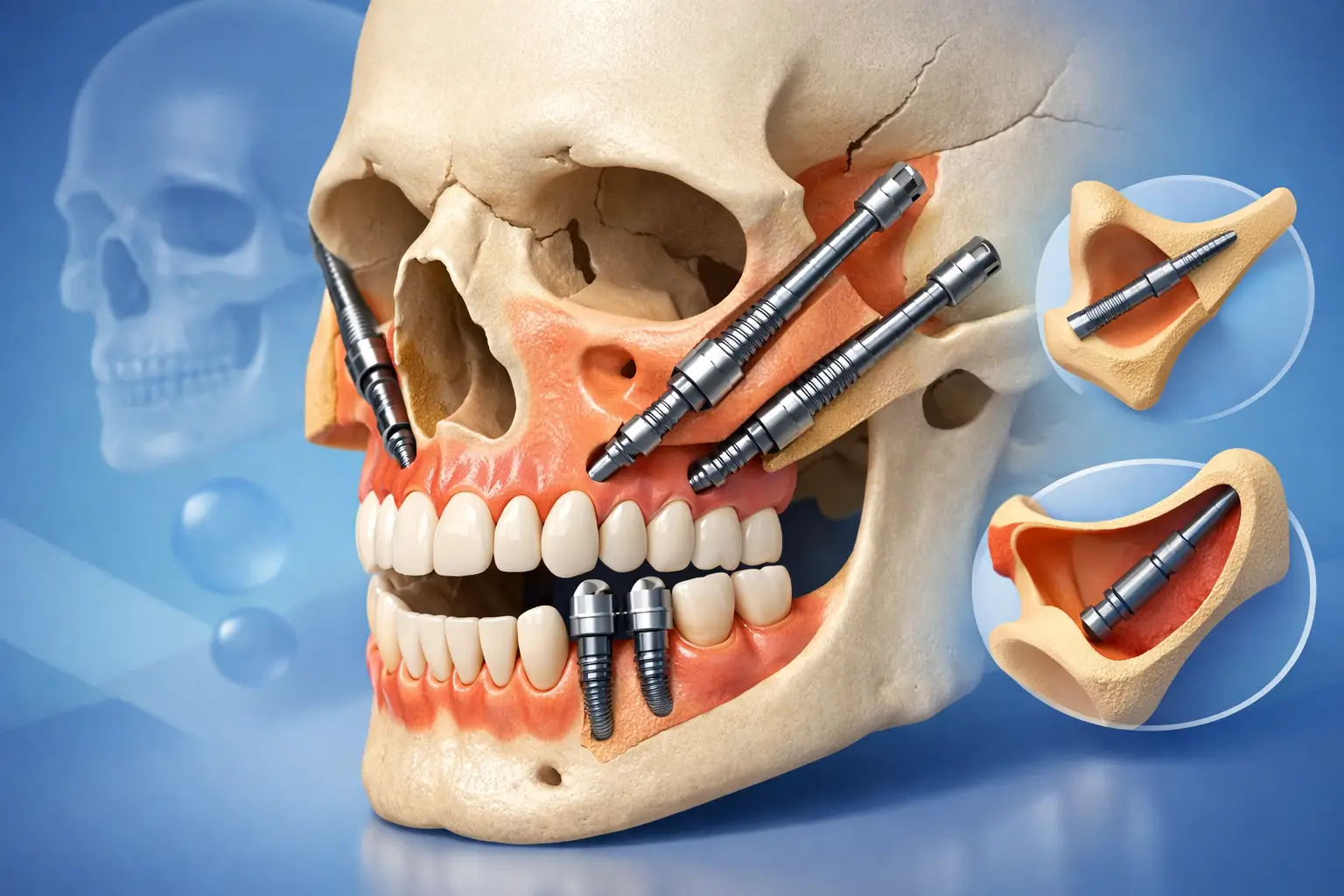
Zygomatic implants solve this by using a different anchorage point. Rather than stopping in the upper jaw, the implant travels through or alongside the maxillary bone and secures into the zygomatic bone. Because the cheekbone is strong, it can support a fixed full-arch restoration even when the upper jaw no longer can.
These implants are much longer than conventional implants. Their length is not a complication in itself. It is simply what allows them to reach the cheekbone safely and gain the stability needed for support. In many cases, they are combined with regular implants at the front of the upper jaw, where some bone may still remain. Together, they create a stable foundation for a fixed bridge.
Why the cheekbone is used
The zygomatic bone is not affected by tooth loss in the same way as the alveolar bone of the upper jaw. When teeth are missing for years, the jaw gradually resorbs because it no longer receives stimulation from chewing forces. That is why many long-term denture wearers are told they are not suitable for ordinary implants.
The cheekbone keeps its density far better. This makes it a reliable anchorage site for carefully planned implant treatment. It is not a shortcut and it is not used for every patient. It is a specialist solution for specific anatomical situations.
That distinction matters. Zygomatic implants are usually recommended when standard implants would have poor support or when bone grafting would make treatment much longer, more complex, or less predictable.
Who is usually suitable for zygomatic implants
This treatment is most often considered for patients with advanced upper jaw bone loss, failed previous implant treatment, severe sinus expansion, or major bone deficiencies caused by periodontal disease or trauma. It can also help patients who want to avoid extensive grafting and the healing delays that come with it.
Suitability still depends on more than bone quantity alone. Overall oral health, gum condition, medical history, bite pattern, and expectations all need to be assessed properly. Smokers, patients with uncontrolled diabetes, or people with untreated oral disease may still need other issues managed first.
For international patients in particular, careful case selection is essential. A treatment plan needs to be realistic, efficient, and based on detailed diagnostics before travel is arranged.
How treatment is planned
The planning stage is where this treatment becomes both safer and more predictable. A full clinical examination is combined with 3D imaging, usually a CBCT scan, to assess bone volume, sinus anatomy, soft tissue position, and the exact angle needed for implant placement.
This digital planning helps the surgical team decide how many implants are needed, where they should sit, and whether the final restoration can be loaded quickly. It also helps identify risks early, which is important because zygomatic implants are technically demanding and should only be placed by experienced clinicians.
At this point, the dentist is not only deciding if the implants can be placed. They are also planning how the final teeth will function, how the bite will be balanced, and how hygiene will be maintained afterwards. A good result is not just about placing implants into bone. It is about building a restoration that feels secure, looks natural, and can be maintained over time.
What happens during the procedure
The procedure is typically carried out under local anaesthetic with sedation or under general anaesthesia, depending on the complexity of the case and the patient's needs. Comfort, medical suitability, and treatment length all influence that decision.
During surgery, the implants are inserted at a precise angle so they engage the zygomatic bone securely. If some useful bone remains in the front of the upper jaw, conventional implants may also be placed there. This creates a balanced support system for the final prosthesis.
Because primary stability is often strong, many patients can receive a temporary fixed bridge very soon after surgery. That means they do not always need to spend months wearing a removable denture while waiting for healing. However, immediate loading depends on stability, bite forces, and the details of the individual case. Sometimes a staged approach is safer.
How zygomatic implants work with fixed teeth
Once the implants are integrated into the treatment plan, they act as anchors for a full-arch bridge. The bridge is attached to the implants rather than resting on the gums like a denture. This gives better retention, greater chewing confidence, and a more stable feeling overall.
For many patients, the practical benefit is immediate. Eating becomes easier, speech often improves, and the movement associated with loose dentures is reduced or eliminated. Aesthetic results also tend to improve because the prosthesis can be designed to restore facial support and smile proportions more effectively.
That said, the final outcome depends on planning and craftsmanship as much as surgery. Implant position, bridge design, gum support, and bite adjustment all play a part in long-term comfort.
The main advantage over bone grafting
The biggest reason patients consider zygomatic implants is that they can avoid or reduce the need for major bone grafting. Traditional graft-based treatment can involve several operations, additional costs, and a healing period that stretches across many months.
Zygomatic implants may shorten that journey considerably. For suitable patients, this can mean fewer surgeries and faster progress towards fixed teeth. That is especially relevant for people travelling from abroad, where time and treatment coordination matter.
Still, avoiding grafting does not automatically mean the treatment is simple. Zygomatic implants are advanced surgery. They require precise imaging, specialist experience, and structured follow-up. The benefit is not that they are easy. The benefit is that they can offer a predictable option when conventional treatment is no longer practical.
Recovery and aftercare
Recovery varies, but swelling, mild bruising, and temporary discomfort are common in the first days after surgery. Most patients can return to light daily activity relatively quickly, although healing instructions need to be followed carefully.
A soft diet is usually recommended at first, particularly if a temporary fixed bridge has been fitted. Oral hygiene is also critical. Fixed teeth still need thorough cleaning around the bridge and implant areas to prevent inflammation and protect long-term stability.
Regular reviews matter just as much as the surgery itself. Any implant treatment can fail if aftercare is neglected. Patients need clear instructions, ongoing support, and realistic guidance about maintenance once they return home. This is one reason clinics with a structured international patient pathway, such as Dentaglobal, place such importance on planning and follow-up communication.
Are there risks or limitations?
Yes, and patients should hear that clearly. Zygomatic implants have high success rates in experienced hands, but they are not appropriate for every case. Because they involve the sinus and neighbouring anatomical structures, placement must be exact. Poor planning or limited surgical experience increases risk.
There are also practical limitations. Some patients may still need additional treatment for gum disease, lower jaw rehabilitation, or bite correction. Others may expect an instant cosmetic result when the real priority is first creating a healthy, stable foundation.
This is why a proper consultation matters more than broad promises. The best treatment is not the most advanced option on paper. It is the one that suits your anatomy, health, goals, and timeline.
If you are living with severe upper jaw bone loss and have been told fixed teeth are no longer possible, it is worth asking for a specialist assessment rather than assuming dentures are your only option. In the right hands, zygomatic implants can turn a difficult case into a realistic treatment plan with far less delay than many patients expect.