

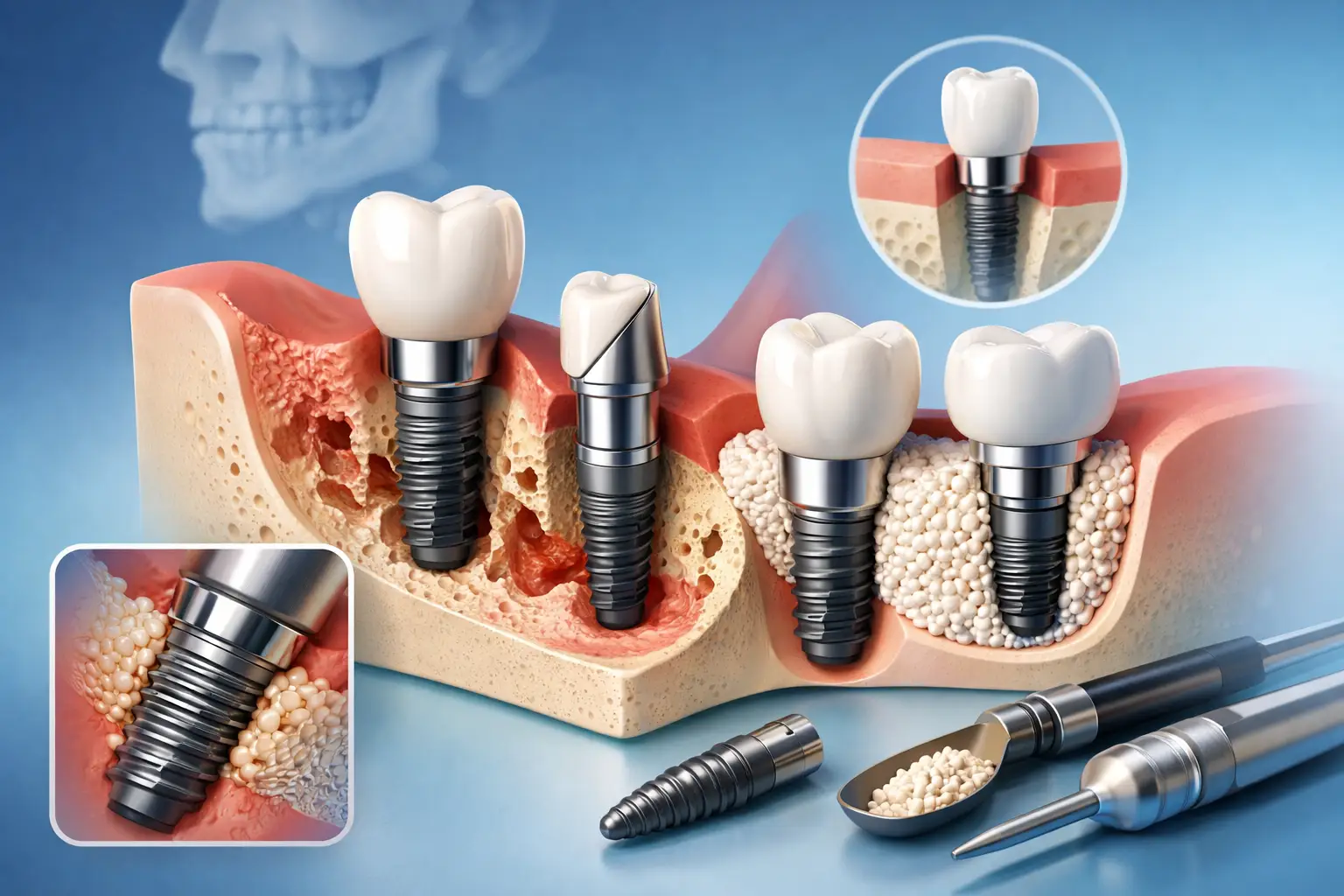
Bone Loss Implant Solutions That Work
13 June 2026Losing a tooth is one problem. Being told you do not have enough bone for an implant is another. For many patients, that second conversation is where the worry starts - not just about treatment, but about time, cost, and whether a fixed smile is still realistic. The good news is that bone loss implant solutions are far more advanced than many people realise, and in many cases there is more than one way forward.
If you have been told your jawbone is too thin, too soft, or too reduced for standard implants, that does not automatically mean you need to give up on fixed teeth. It means the treatment plan needs to be more precise. The right solution depends on where the bone loss is, how severe it is, how many teeth are missing, and how quickly you want to complete treatment.
Why bone loss changes implant planning
Dental implants need support from healthy bone. When a tooth is lost, the jaw in that area no longer receives the pressure and stimulation created by chewing. Over time, the bone begins to shrink. Gum disease, long-term denture wear, infection, trauma, and delayed treatment can all make this worse.
This matters because implant stability depends on bone volume and bone density. If there is not enough of either, a standard implant may not achieve the strength needed for long-term success. That is why careful assessment comes first. A proper plan usually starts with 3D imaging, not guesswork, so the surgeon can see bone height, width, sinus position, and nerve location clearly.
In practice, bone loss does not create one single problem. A patient missing one upper molar may need a very different solution from someone who has worn full dentures for years. That is why broad advice such as "you need bone grafting" can be too simplistic. Sometimes grafting is the best route. Sometimes it is not necessary at all.
Bone loss implant solutions for mild to moderate cases
When bone loss is present but not extreme, treatment often focuses on rebuilding or preserving enough bone for conventional implants. This can be a strong option for patients who want a traditional implant approach and are happy to accept a staged treatment plan.
Bone grafting
Bone grafting is one of the most common methods used to increase bone volume before implant placement. The aim is to rebuild a deficient area so that an implant can be placed in a safer, more stable position.
For a single missing tooth or a small localised defect, grafting can work very well. The trade-off is time. In many cases, the graft must heal for several months before the implant can be placed, although some patients can have grafting and implant placement at the same appointment. It depends on the quality of the existing bone and the size of the defect.
From a patient point of view, grafting can be worthwhile when it improves long-term implant positioning and appearance, especially in visible areas. However, it may not be the most efficient answer for someone with severe full-arch bone loss who wants to avoid multiple surgical stages.
Sinus lift procedures
Bone loss in the upper back jaw is especially common because the sinus can expand after teeth are lost, reducing the amount of available bone. In these cases, a sinus lift may be used to create more vertical bone height.
This is a predictable treatment in suitable cases, but it is another example of a solution that can lengthen the overall timeline. For some patients, that is acceptable if it allows the use of conventional implants. For others, especially those coming from abroad for treatment, alternatives that reduce treatment stages may be more practical.
Short or narrow implants
Not every reduced bone case requires grafting. In selected situations, short implants or narrow implants can be used to avoid more invasive bone augmentation. This is particularly helpful where the available bone is limited but still strong enough to support implant stability.
The benefit is a simpler treatment path. The limitation is that these implants are not appropriate for every site or every bite pattern. Case selection matters. A good implant plan is not about choosing the least invasive option by default. It is about choosing the option most likely to perform well under real chewing forces over time.
Advanced bone loss implant solutions
When bone loss is more significant, standard planning often gives way to more strategic implant techniques. These approaches are especially relevant for patients missing many teeth or living with long-term denture-related bone reduction.
All-on-4 and All-on-6 concepts
For full-arch restoration, angled implants can often be placed in areas where bone is naturally stronger, avoiding the need for extensive grafting. This is the principle behind All-on-4 and All-on-6 treatment.
Instead of replacing every missing tooth with a separate implant, a full bridge is supported by four or six carefully positioned implants. For many patients with moderate bone loss, this creates a fixed solution without the delays associated with widespread grafting.
This can be particularly attractive for international patients because treatment time is often more manageable. In many cases, temporary fixed teeth can be provided quickly, which means you are not waiting months without a functional smile. That said, not every full-arch case suits the same design. Bone quality, bite force, and aesthetic goals all affect whether four implants are enough or whether six provide a more secure foundation.
Zygomatic implants
For severe bone loss in the upper jaw, zygomatic implants can be a powerful option. Rather than relying on the reduced upper jawbone, these longer implants anchor into the cheekbone, where bone quality is typically stronger.
This approach is often considered when patients have been told they need extensive grafting, sinus augmentation, or may not be suitable for upper implants at all. In the right hands, zygomatic implants can reduce the need for complex graft-based reconstruction and offer a fixed solution in cases that might otherwise seem difficult.
They are not a routine implant for every patient, and they do require advanced surgical planning and experience. But for severe maxillary bone loss, they can change the conversation completely. Instead of asking whether implants are possible, the focus shifts to which advanced method is safest and most efficient.
Pterygoid or tilted implant approaches
In some upper jaw cases, tilted posterior implants can help avoid sinus grafting by using available bone more effectively. These techniques are not suitable for everyone, but they can be valuable when the aim is to deliver a fixed full-arch result while limiting additional surgery.
This is where specialist-led planning becomes especially important. Two patients can have similar X-rays and still require different approaches because anatomy, smile line, and bite mechanics are not identical.
How the right solution is chosen
Choosing between grafting, standard implants, full-arch systems, and advanced options is not only about clinical possibility. It is also about what matters most to you.
If your priority is the most conventional implant placement possible, and you do not mind a longer process, grafting may be the right route. If you want to reduce appointments and avoid months of healing between stages, graft-free full-arch options may be more suitable. If you have severe upper jaw bone loss, specialist treatments such as zygomatic implants may offer a more direct answer.
A well-run assessment should cover several points clearly: the amount of bone available, whether immediate implants are realistic, whether temporary teeth can be fitted, the expected treatment timeline, and what maintenance will be needed afterwards. Patients should not feel pushed towards the most complex solution if a simpler one is clinically sound. Equally, they should not be offered a basic solution that compromises stability just because it sounds easier.
What international patients should consider
For patients travelling for implant treatment, planning needs to be especially organised. Bone loss cases can involve more variables, so clear diagnostics and communication before travel are essential.
This is one reason digital planning matters so much. When scans and clinical evaluation are used properly, it is often possible to design a treatment route that is efficient without being rushed. Clinics experienced in complex implant work can often coordinate consultation, surgery, temporary restoration, and review in a way that makes treatment abroad more predictable.
At Dentaglobal, this kind of structured planning is particularly important for patients who want advanced implant care with a clear timeline and dependable aftercare. For someone balancing cost, travel, and clinical quality, that clarity can make the process far less stressful.
Questions patients often ask about bone loss implant solutions
One of the most common questions is whether dentures are the only option after severe bone loss. In many cases, the answer is no. Even where standard implants are not suitable, advanced full-arch techniques may still allow fixed teeth.
Another concern is whether more bone loss means implants will fail. Not necessarily. Poor planning causes more problems than bone loss alone. When the implant type and position match the anatomy properly, outcomes can be very strong.
Patients also ask whether treatment will take years. Sometimes graft-based treatment can be lengthy, but not every bone loss case follows that path. Some advanced solutions are specifically designed to shorten treatment and reduce the number of surgical stages.
If you have been told you are not suitable for implants, it is often worth asking a more specific question: not "Can I have implants?" but "Which bone loss implant solutions fit my anatomy, timeline, and goals?" That shift matters. The answer is often more encouraging than expected.
A missing tooth changes your smile. Bone loss changes the strategy. With modern imaging, specialist planning, and the right implant technique, many patients who assumed they had run out of options can still move towards a stable, fixed result with confidence.