

All on 4 vs All on 6: Which Fits Best?
14 April 2026Losing most or all of your teeth changes more than your smile. It affects how you eat, how clearly you speak, and how confident you feel in social situations. When patients compare all on 4 vs all on 6, they are usually trying to answer one practical question: which option will give me a secure, natural-looking result that lasts, without paying for more treatment than I need?
That is the right question to ask. Both treatments are designed to replace a full arch of missing or failing teeth with a fixed prosthesis supported by dental implants. Both can deliver a major improvement in comfort, function and appearance. But they are not identical, and the best choice depends on your bone volume, bite forces, oral health history, treatment goals and budget.
What is the difference between all on 4 vs all on 6?
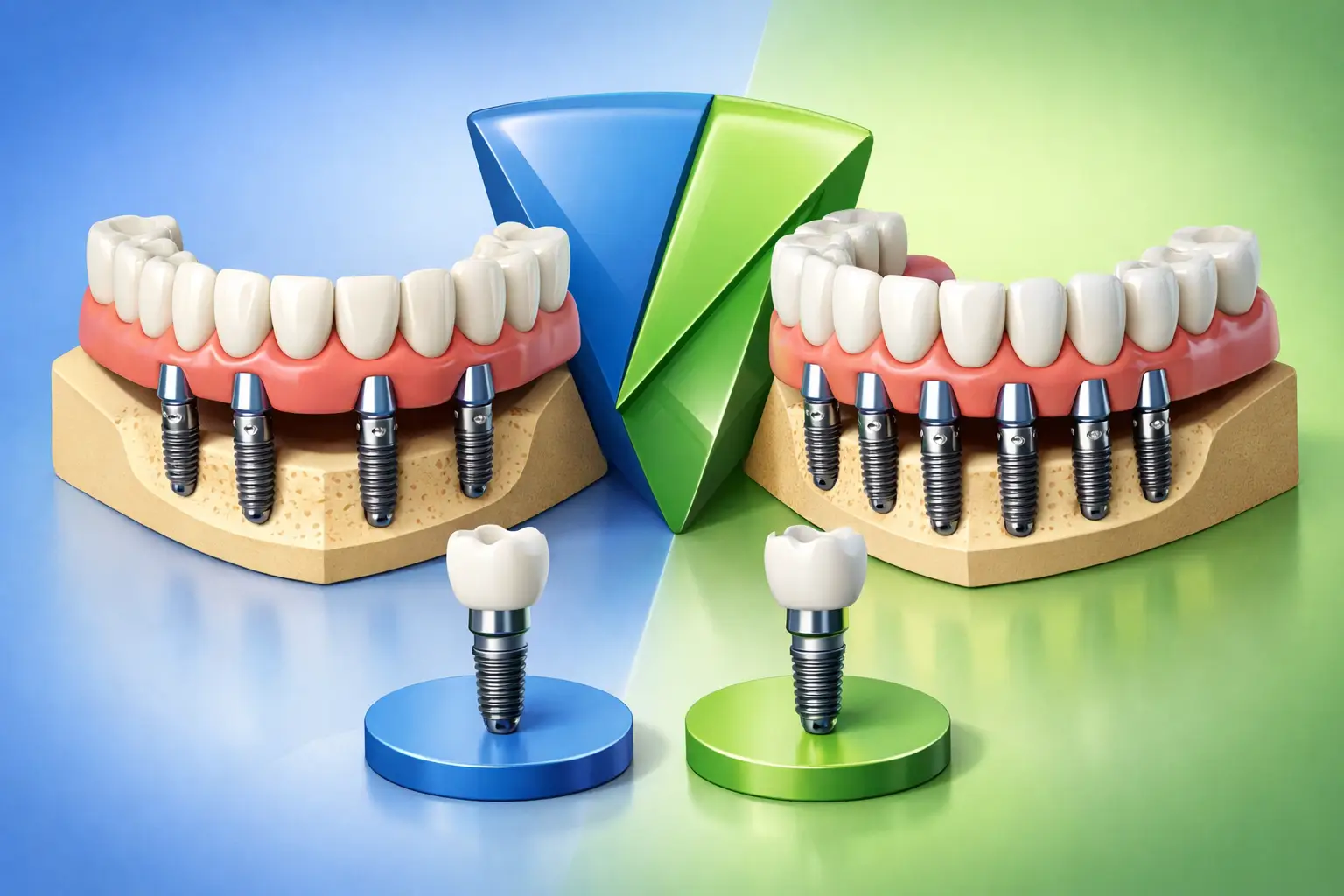
The basic difference is in the number of implants used to support a full-arch restoration. All-on-4 uses four implants per arch, while All-on-6 uses six. In both systems, the implants are placed strategically into the jawbone, and a fixed bridge is attached to create a full set of replacement teeth.
With All-on-4, the rear implants are often angled to make better use of available bone and avoid anatomical structures such as the sinus in the upper jaw or the nerve in the lower jaw. This approach can reduce the need for bone grafting in some patients. With All-on-6, two additional implants are placed to distribute force more widely across the arch. That extra support can be useful for patients with stronger bite pressure or where long-term load distribution is a priority.
On paper, the difference sounds simple. In real treatment planning, it affects stability, eligibility, cost, and sometimes the overall complexity of the case.
All on 4 vs all on 6 for support and stability
If you think of a full-arch bridge like a structure that needs even support, six anchors will usually spread pressure more evenly than four. That does not mean All-on-4 is weak. It is a proven treatment with excellent outcomes in suitable cases. But All-on-6 may offer an advantage in mechanical support, especially in patients who clench, grind, or place heavier functional demands on their teeth.
This matters most over time. A full-arch restoration handles repeated chewing forces every day. More implants can reduce the strain on each individual implant and may support better force distribution across the prosthesis. For some patients, that provides added reassurance and may contribute to long-term durability.
That said, more implants are not automatically better in every mouth. If bone quality is limited or anatomy is challenging, placing six implants may not be possible without additional procedures. In those situations, four well-positioned implants may be the more predictable option.
Is All-on-6 always stronger?
Not always in a way that changes the patient experience. If your bone support is good and your case is planned properly, both options can feel secure and function very well. The real issue is suitability, not simply numbers. An experienced implant team will look at your scan, bite, medical history and expectations before recommending one over the other.
Bone availability and treatment planning
One of the biggest factors in the all on 4 vs all on 6 decision is the amount and quality of bone available in the jaw. After tooth loss, the jawbone gradually shrinks. Some patients still have enough bone for multiple implants, while others do not.
All-on-4 was developed partly to help patients who have reduced bone volume but still want a fixed solution. By angling the back implants, the clinician can often use the denser bone that remains and avoid more invasive grafting procedures. This can shorten treatment time and make the process more accessible.
All-on-6 generally requires sufficient bone in more implant positions. If that bone is available, it can be an excellent option. If not, bone grafting or alternative implant strategies may be needed. In advanced upper jaw cases, specialist approaches such as zygomatic implants may also be considered, but that is a separate treatment pathway.
For international patients, this is why a proper digital assessment matters before booking treatment. Photographs help, but a panoramic image or 3D scan gives a much clearer picture of what is realistically possible.
Cost differences patients should expect
Cost is a realistic part of the decision, and most patients want clarity early on. In general, All-on-6 costs more than All-on-4 because it uses two additional implants and may involve more surgical time, more components and a more complex prosthetic plan.
However, lower upfront cost should not be the only deciding factor. The better question is value. If six implants give you a more suitable and stable foundation for your bite and bone condition, paying less for four may not be the smartest long-term choice. Equally, if four implants can provide a safe and durable result without unnecessary extras, there may be no reason to increase the scope of treatment.
A trustworthy treatment plan should explain what is included, why the recommendation has been made, and whether there are any likely additional procedures such as extractions, temporary teeth or bone management.
Healing time and immediate teeth
Patients often ask whether one option heals faster than the other. In many cases, healing timelines are broadly similar. Both All-on-4 and All-on-6 can be used in immediate loading protocols, where temporary fixed teeth are attached soon after surgery if implant stability is strong enough.
Immediate teeth are popular because they reduce the time spent without a proper smile and allow patients to leave the clinic with a fixed restoration rather than a removable denture. But immediate loading is not guaranteed in every case. It depends on insertion torque, bone quality, overall health and whether infection or significant bone loss is present.
The number of implants is only one part of that decision. Four stable implants may be enough for immediate function. Six implants may also support immediate loading well. The final call is clinical, not cosmetic.
Does more implants mean a harder recovery?
Not necessarily. Some swelling and tenderness are expected after either procedure, but most patients are surprised that recovery is manageable with the right aftercare. The main difference is not usually discomfort. It is whether the additional implants improve the long-term treatment plan enough to justify them.
Aesthetics and day-to-day comfort
From the patient’s point of view, the visible result can be excellent with both treatments. The look of the final smile depends less on whether there are four or six implants and more on the quality of planning, smile design, gum support, bite alignment and the materials used for the prosthesis.
Speech and comfort also depend on design. A full-arch bridge should feel stable, support facial appearance and allow comfortable eating once healing is complete. If the bridge is well made and properly fitted, most patients adapt quickly.
What matters is that the restoration is designed for your face, lip support and bite pattern rather than treated as a standard one-size-fits-all appliance.
Who is a better candidate for each option?
All-on-4 may be more suitable if you have reduced bone volume, want to avoid grafting where possible, or need a cost-conscious fixed full-arch solution. It is also commonly chosen when anatomy limits implant placement in the posterior jaw.
All-on-6 may be a better fit if you have sufficient bone, a stronger bite, or want extra implant support across the arch. It can be especially attractive for younger full-arch patients or those looking for added load distribution over time.
Neither system is automatically the premium version of the other. They are different solutions for different clinical situations. A patient with limited bone may do very well with All-on-4, while another with good bone and higher bite demands may benefit from All-on-6.
How to choose safely
The safest way to decide between all on 4 vs all on 6 is to avoid choosing based on adverts alone. The right recommendation should come after a proper consultation, radiographic review and a discussion about your goals. That includes questions many patients do not think to ask at first, such as whether you grind your teeth, whether you have had long-term gum disease, and what type of final bridge is planned.
For patients travelling abroad for implant treatment, planning and follow-up become even more important. Clear communication, digital diagnostics, a structured treatment schedule and post-treatment support are not extras. They are part of safe care. Clinics experienced in international full-mouth rehabilitation, including providers such as Dentaglobal, usually build the process around those needs because travelling patients need certainty before they book flights and accommodation.
If you are deciding between the two, focus on fit rather than labels. The best treatment is the one that matches your bone, your bite and your long-term needs, while giving you confidence that the result has been planned properly from the start. A fixed smile should not only look good on the day it is fitted. It should feel dependable every day afterwards.