

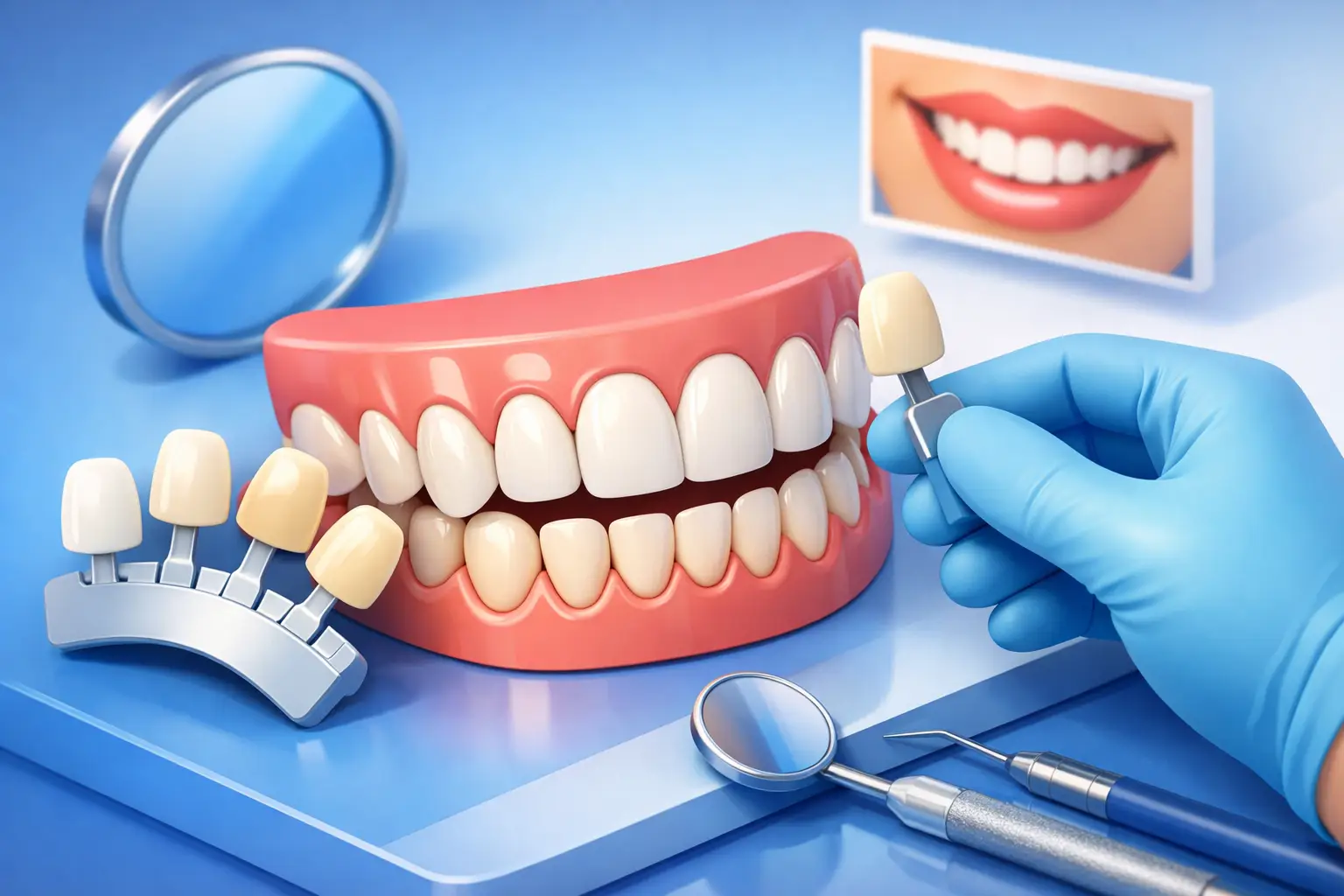
How to Choose Veneers Shade for a Natural Smile
20 August 2026A veneers shade can look beautifully bright in a clinic photograph yet feel too white when you see it in daylight, on a video call or beside your natural teeth. That is why learning how to choose veneers shade is not simply about selecting the whitest option on a shade guide. It is about finding a colour that suits your face, complements any visible natural teeth and still feels like you.
For patients planning treatment abroad, this decision deserves particular care. Veneers are designed to be long-lasting, so the right shade should work for your everyday life at home, not only for the excitement of a new smile on treatment day.
How to choose veneers shade with confidence
A good veneer shade is usually one that people notice as healthy and attractive before they notice it as dental work. Very bright veneers can look striking, but brightness alone does not create a natural result. The best choice depends on your complexion, lip colour, facial features, age, existing teeth and the material selected for your restoration.
During a professional consultation, the dentist does not choose a shade in isolation. They assess your smile at rest and when speaking, the amount of tooth visible, the colour of neighbouring teeth and how light reflects from your enamel. Digital smile design, clinical photographs and shade matching help turn a general preference such as “white but natural” into a treatment plan with clear visual goals.
Start with your desired look, not the shade chart
Shade charts use letter and number combinations that can seem technical at first. In simple terms, they help dentists compare tooth colours by hue, brightness and intensity. The lightest options may be labelled as bleach shades, while more traditional shades are organised from lighter to darker and warmer to cooler tones.
Before focusing on a code, describe the result you want. Do you want a subtle improvement that blends with your natural teeth? A polished, camera-ready smile? Or a noticeably brighter cosmetic transformation? There is no universally correct answer, but clarity about the look you want helps your dentist recommend a realistic range.
Bringing a few photographs of smiles you genuinely like can be useful. Choose images in natural light where possible, rather than heavily edited celebrity photos. Your dentist can explain whether the appearance comes from shade alone or also from tooth shape, translucency, gum contours and lip position.
Consider your skin tone, eyes and facial colouring
Teeth do not exist separately from the rest of the face. A shade that looks balanced on one person may look artificial on another because of differences in skin undertone, hair colour and facial contrast.
Patients with cooler skin undertones may often suit clean, neutral white shades well. Warmer complexions can look particularly natural with a slightly warmer ivory or soft white, rather than a blue-white finish. This is only a guide, not a rule. The goal is to avoid a shade that creates a stark contrast unless that is a deliberate part of your preferred aesthetic.
Age can also influence the decision, although it should never dictate it. Natural enamel tends to become less translucent and slightly warmer over time. A mature patient may prefer a bright but softened shade that looks refined, while a younger patient may favour more luminosity. Both can be excellent choices when planned around the individual face.
Match veneers to visible natural teeth
If veneers are being placed on only a few front teeth, matching the surrounding natural teeth is essential. Your new veneers should blend with the canines, lower teeth and any upper teeth that show when you smile. Choosing a much whiter shade for two veneers while leaving adjacent teeth darker can make the restorations stand out for the wrong reason.
This is why whitening, if desired, is usually considered before final shade selection. Professional teeth whitening can alter the colour of natural enamel, but it will not lighten existing crowns, fillings or veneers. Once your natural teeth have reached a stable colour, the dentist can match your final veneers accurately.
For a larger smile makeover involving six, eight or ten upper veneers, there is more freedom to choose a brighter shade because more of the visible smile is being harmonised. Even then, lower teeth and posterior teeth may remain visible when you speak or laugh, so they must be included in the assessment.
Think about lighting beyond the dental chair
Dental clinics use controlled lighting because it supports accurate shade evaluation. However, your veneers will be seen in many settings: cloudy daylight in Britain, warm restaurant lighting, office lighting, flash photography and mobile phone cameras. Each can change how white or warm teeth appear.
A reliable shade selection process considers more than one light source. Your dentist may use photographs, calibrated digital tools and physical shade tabs to compare options. If you are travelling for treatment, discuss your expectations before arrival and provide clear, unfiltered photographs where requested. This gives the clinical team a useful starting point, although the final choice should always be confirmed in person.
Do not judge a proposed shade solely from a screen. Mobile phone displays vary significantly, and filters can make even natural veneers appear ultra-white. A temporary mock-up or trial smile, where clinically appropriate, can be more valuable because it lets you see the proportion, shape and overall brightness on your own face.
Choose brightness carefully
It is understandable to want the whitest veneers available, especially if you have spent years feeling self-conscious about discoloured teeth. Yet the brightest shade is not always the most flattering or the most convincing. Extremely opaque, brilliant white veneers can lose the subtle depth found in natural teeth.
Porcelain veneers can be made with varying levels of translucency. This matters because natural enamel reflects and transmits light rather than looking like a flat white surface. A skilled dental laboratory can combine the chosen base shade with surface texture, gentle translucency near the incisal edge and small tonal variations to create a more lifelike result.
Composite veneers can also provide an attractive improvement, often with a more conservative approach, but they may stain or lose lustre more readily than porcelain over time. The material, thickness of the veneer and colour of the underlying tooth can all affect the final shade. Your dentist should explain these practical differences before treatment begins.
Avoid choosing from a single reference photo
A reference image is helpful, but it should not become a fixed promise. A smile that suits a person with different facial proportions, gum display and tooth shape may not translate directly to your own mouth. Equally, photos of “before and after” treatments can be affected by lighting, camera settings and image editing.
Instead, use reference images to communicate direction. You might say that you prefer a soft, natural white, a smooth Hollywood-style finish or a brighter but not blue-toned result. This gives your dentist room to tailor the shade and design to your features while keeping your preferences central to the plan.
At Dentaglobal, treatment planning for cosmetic cases is supported by digital dentistry and specialist assessment, helping patients review their options with a clearer understanding of the expected result. For international patients, this structured approach is particularly reassuring because it allows shade, design and treatment timing to be discussed before travel.
Ask these questions before final approval
Before the veneer shade is confirmed, make sure you understand how it will relate to the rest of your smile. Ask whether your natural teeth should be whitened first, whether existing crowns or fillings will remain visibly different, and how the shade may appear in daylight. It is also sensible to ask if the veneers will have natural translucency or a more opaque finish.
If you are having a full-mouth rehabilitation, the question becomes broader. The shade of crowns, bridges and implant restorations must be planned together so the smile remains consistent. This is not a case for selecting each restoration separately. A coordinated plan protects both appearance and function.
You should also be open about concerns. If you worry that a proposed shade is too bright, too warm or too uniform, say so before the final restorations are bonded. Minor adjustments may be possible during planning, but changing the shade after placement can mean replacing the veneers.
Give yourself permission to choose natural
A successful veneer smile does not need to look identical to anyone else’s. The right shade may be a high-impact white, or it may be a softer colour that makes your teeth look healthy, even and naturally yours. What matters is that the result feels comfortable when you catch your reflection in ordinary daylight, months and years after treatment.
Choose a dentist who listens closely, shows you the options clearly and plans the shade as part of your whole smile, not as a quick cosmetic decision. That careful conversation is where a bright new smile becomes a believable one.