


Full Mouth Restoration Guide for Patients
8 April 2026When eating starts to feel like work, smiling becomes something you avoid, and one dental problem keeps leading to another, you are usually past the point of a single filling or crown fixing everything. A full mouth restoration guide helps make sense of that stage - when function, comfort and appearance all need attention together, not one tooth at a time.
For many patients, especially those comparing treatment at home with options abroad, the biggest question is not just what can be done. It is what should be done first, how long it will take, and whether the result will actually last. That is where a structured plan matters.
What full mouth restoration really means
Full mouth restoration is a personalised treatment plan that rebuilds or replaces multiple teeth across the upper and lower jaws. The aim is not purely cosmetic. It is to restore biting ability, speech, comfort, gum health and facial support while also improving the appearance of the smile.
This type of treatment is often recommended when several issues exist at the same time. You may have missing teeth, worn teeth, failing crowns or bridges, gum disease, jaw discomfort, bite collapse, repeated infections, or teeth that are too damaged for simple repair. In these cases, treating one area without considering the whole mouth can create new problems elsewhere.
A proper restoration plan looks at how your teeth meet, how your gums and bone support treatment, and which teeth can be saved safely. It also considers your priorities. Some patients want the most conservative route. Others want speed, fewer appointments, or a full fixed implant solution.
Who may need a full mouth restoration guide
You do not need to have lost all your teeth to need full mouth rehabilitation. Many patients still have a mix of natural teeth, old dental work and gaps. The real sign is complexity, not the exact number of missing teeth.
You may be a candidate if you have widespread tooth wear from grinding, several broken or heavily filled teeth, advanced gum disease, multiple missing teeth, or long-term bite problems that affect chewing and comfort. Patients who have delayed treatment for years often reach this point gradually, then all at once.
This is also common among people who want to combine health needs with cosmetic improvement. If your teeth are structurally compromised, whitening or veneers alone are not the answer. First, the mouth needs to be stable.
The first stage of full mouth restoration planning
The planning stage is where good outcomes begin. A rushed quote based on a few photos is not enough for complex work. Detailed assessment usually includes clinical examination, digital X-rays, panoramic imaging, and often 3D scans or CBCT to check bone levels, roots and implant suitability.
At this stage, your dentist is looking for three things. First, what must be treated because it is diseased or failing. Second, what can be preserved. Third, how to rebuild the bite in a way that is functional and predictable.
This often reveals trade-offs. Saving a weak tooth may feel cheaper in the short term but lead to retreatment later. Removing too many teeth too quickly may simplify the plan but be more invasive than necessary. The right approach depends on biology, budget, timeline and long-term goals.
Treatments commonly used in a full mouth restoration guide
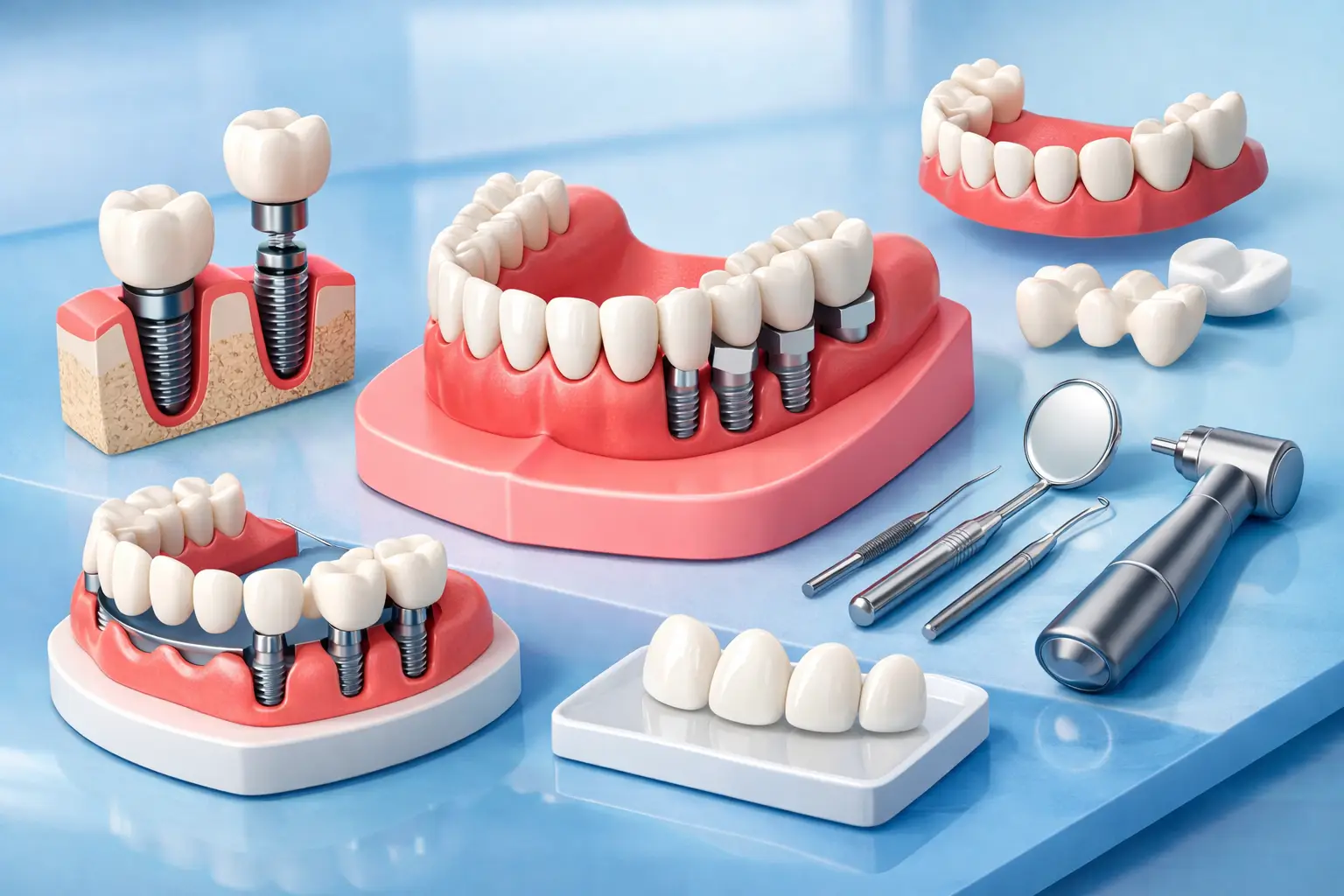
Most full mouth cases involve a combination of treatments rather than one single procedure. Crowns may be used to strengthen damaged teeth. Bridges can replace one or more missing teeth when nearby teeth are suitable as support. Dental implants are often chosen for individual gaps or full-arch fixed restorations because they help preserve bone and provide strong support.
If many teeth are missing or beyond repair, full-arch implant concepts such as All-on-4 or All-on-6 may be discussed. These approaches use a set number of implants to support a fixed bridge for the whole upper or lower arch. They can be highly effective, but they are not identical solutions for every patient. Bone quality, bite forces, anatomy and aesthetic demands all influence which design is best.
Some patients also need periodontal treatment before restorative work begins. Others need root canal treatment, extractions, bone grafting or sinus lift procedures. Orthodontics can sometimes be part of the plan if tooth position is creating bite or spacing problems, although in heavily damaged cases restorative treatment is often the more direct route.
Saving teeth or replacing them
This is one of the most important decisions in any full mouth restoration guide. Natural teeth are valuable, but not every tooth is worth saving at any cost. A tooth with severe bone loss, fracture or repeated infection may compromise the wider plan.
On the other hand, replacing every compromised tooth with implants is not automatically better. Implant treatment is excellent in the right hands, but it still depends on healthy bone, good planning and proper maintenance. Keeping strategic natural teeth can sometimes reduce treatment complexity and cost.
The best plans are balanced. They preserve what is predictable and replace what is not.
How long treatment usually takes
Timelines vary more than patients expect. Some full mouth cases can be completed within a short, organised schedule if the work is mainly crowns, bridges or veneers on healthy foundations. Cases involving implants, healing periods or grafting take longer.
If implants are placed, the bone may need several months to integrate before the final prosthetics are fitted. In some cases, immediate temporary teeth are possible, which is especially helpful for patients who do not want to be without teeth while healing. That said, immediate solutions are not suitable for everyone.
For international patients, planning matters as much as the dentistry. A two-visit model is common for implant-based cases - one visit for diagnostics, any extractions and implant placement, and a later visit for final restorations after healing. More straightforward cases may be completed in one stay, depending on clinical findings.
Cost, value and what affects the quote
Patients often search for a full mouth restoration guide because cost is difficult to understand. The price can vary significantly because the treatment itself can vary significantly. Two people with the same number of missing teeth may need very different solutions.
The main cost factors are the number of teeth or arches involved, whether implants are needed, the material used for crowns or bridges, the need for bone grafting, and the complexity of the bite reconstruction. Diagnostics, sedation, temporaries and aftercare can also affect the total figure.
Value is not just the lowest quote. It is the quality of planning, the experience of the clinicians, the technology used, and the reliability of support before and after treatment. For patients considering treatment abroad, this is especially relevant. A lower fee only makes sense if the process is well managed and the clinical standards are consistent.
Why many patients choose treatment abroad
Dental tourism is not only about saving money. For many people, it is about accessing comprehensive treatment faster, with a more coordinated pathway. Clinics that regularly treat international patients tend to be better prepared for remote consultations, condensed appointment schedules, multilingual communication and post-treatment follow-up.
At Dentaglobal, this structured approach is a major part of the patient journey. For full mouth cases, clarity matters. You need to know what is included, how many visits are likely, what healing periods are expected and what support continues after you return home.
Still, treatment abroad is not for every case or every patient. If you have complex medical conditions, need frequent in-person reviews, or cannot travel comfortably, local staged treatment may be the better option. A good clinic will say that honestly.
Questions to ask before you commit
Before agreeing to treatment, ask how the plan was built and whether alternatives were considered. You should understand which teeth are being saved, which are being removed, and why. Ask whether temporary restorations will be provided, what the final materials will be, and how your bite will be tested before completion.
It is also sensible to ask about guarantees, expected maintenance, hygiene requirements and what happens if adjustments are needed after you return home. Full mouth restoration is a major investment. Clear answers are part of good care, not an extra.
Life after treatment
A successful restoration should feel stable, comfortable and natural in daily life. That does not mean maintenance disappears. Crowns, bridges and implant restorations still need proper cleaning, routine reviews and protection from grinding if that is part of your history.
The biggest difference many patients notice is not just aesthetic. It is relief. Eating becomes easier, speech feels more confident, and the constant cycle of temporary fixes stops. When the plan is built properly, treatment does not simply change the smile. It gives the whole mouth a more reliable future.
If you are weighing your options, focus on a plan that makes clinical sense, fits your circumstances and is explained in plain language. The right full mouth restoration is not the fastest or the cheapest on paper. It is the one that lets you move forward with confidence.