

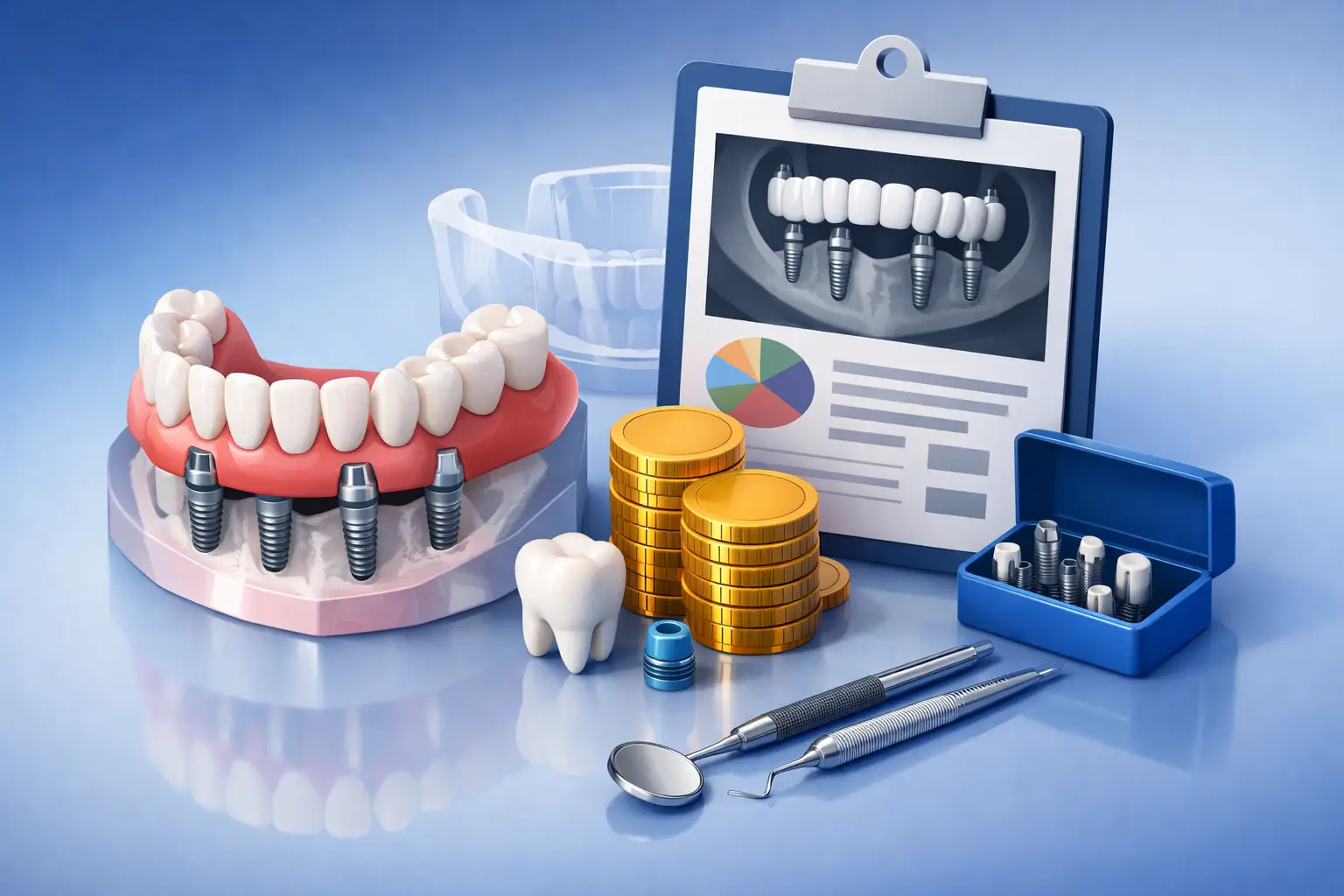
What Full Arch Implant Costs Really Include
18 August 2026A full-arch restoration is not simply a set of replacement teeth. It is a planned reconstruction of your bite, smile, comfort and everyday function. That is why full arch implant costs can vary widely between clinics and countries. A meaningful quote should explain not just the final figure, but the clinical work, materials and support behind it.
For patients considering treatment abroad, the right question is not only, “How much does it cost?” It is, “What is included, who is planning my case, and how will the result be supported after treatment?”
What full arch implant costs cover
A full-arch implant treatment replaces all teeth in the upper jaw, lower jaw, or both. It commonly uses an All-on-4 or All-on-6 approach, where a fixed bridge is supported by four or six strategically placed dental implants. The number of implants, type of final bridge and condition of your jawbone all influence the treatment plan.
A complete cost should typically account for your consultation and diagnostic scans, treatment planning, any necessary extractions, implant placement, temporary teeth, the final fixed restoration, clinical reviews and post-treatment guidance. If one of these stages is absent from a quote, it is worth asking whether it will be charged separately later.
The difference between an initial temporary bridge and a final bridge is particularly important. Temporary teeth are designed to help you smile and function while your implants integrate with the bone. The final bridge is made after healing and should be planned for long-term strength, bite accuracy and appearance. Comparing quotes without confirming whether the final bridge is included can lead to misleading price comparisons.
The main factors that affect the price
The number and position of implants
All-on-4 is often suitable when the front section of the jaw has enough healthy bone and implants can be angled to make the best use of it. All-on-6 may provide additional support, particularly where bite forces are higher or the clinical situation calls for a wider distribution of support.
More implants do not automatically mean a better result for every patient. The appropriate number depends on bone quality, jaw anatomy, bite, opposing teeth and the type of restoration being planned. A specialist-led assessment is more valuable than a one-size-fits-all recommendation.
Bone loss and additional procedures
Long-term tooth loss, gum disease and infection can reduce the volume of available jawbone. Some patients need bone grafting, sinus lifting or periodontal treatment before implants can be placed safely. These procedures add clinical time, materials and healing considerations.
In more complex upper-jaw cases, zygomatic implants may be considered. These longer implants anchor into the cheekbone and can avoid extensive grafting for selected patients with severe bone loss. They are highly specialised and naturally affect the overall cost of treatment.
Your final bridge material
The final prosthesis has a major effect on full arch implant costs. It also affects appearance, strength, repairability and long-term maintenance. Common options include acrylic-based bridges, porcelain-fused restorations and monolithic zirconia bridges.
An acrylic or composite bridge may be a practical starting option and can be easier to modify or repair. Zirconia is valued for its durability, natural-looking finish and resistance to staining, but it requires careful digital design and precise bite planning. The most suitable material depends on your aesthetic goals, bite forces, budget and how much support your lips and facial profile need from the bridge.
Digital planning and clinical technology
Full-arch treatment should not rely on guesswork. Digital scans, 3D imaging and computer-guided planning allow the clinical team to assess bone volume, nerve pathways, sinus position and the intended tooth position before surgery.
Technology contributes to the cost, but it also supports safer planning and a more predictable result. Digital workflows can help ensure that implant placement, temporary teeth and final restoration work together as one coordinated treatment plan rather than separate appointments with separate assumptions.
The experience behind the treatment
A lower price can be attractive, but the clinical team matters as much as the materials used. Full-arch rehabilitation involves oral surgery, implant dentistry, prosthetic design and bite management. Cases are often best delivered through collaboration between specialists, rather than by treating implant placement and the final smile as unrelated stages.
Ask who will carry out each part of your treatment, how your case will be reviewed and whether the clinic has experience with complex bone loss or restorative complications. Clear answers build confidence before you commit.
Comparing full arch implant costs fairly
Two quotes can look similar on paper while covering very different levels of care. Before making a decision, request a written treatment plan that identifies the implant system, number of implants, bridge material, temporary restoration and final restoration.
You should also confirm whether the quoted price includes extractions, sedation if required, scans, laboratory fees, medication, review appointments and any required adjustments. For international patients, it is sensible to ask how many visits are expected, how long each stay will be, and whether coordination support is available for appointment scheduling.
A useful comparison is the total treatment cost rather than the advertised starting price. This includes dental treatment, flights, accommodation, local transfers, meals and a sensible contingency for an extended stay if your clinical timetable changes. Turkey can offer meaningful value for patients from the UK and Europe, but travel should never replace proper planning.
Why treatment may be staged
Many full-arch cases are completed in phases. After implant placement, a temporary fixed bridge may be fitted on the same day or soon afterwards, depending on implant stability and your individual clinical conditions. The final bridge is then produced once healing has progressed and your bite can be assessed more accurately.
This staged approach can feel less convenient than receiving a final bridge immediately, but it often protects the long-term result. Your gums and bone remodel during healing. Giving the team time to refine your smile, speech and bite before fitting the definitive restoration can improve comfort and reduce avoidable adjustments later.
For patients travelling from abroad, a well-organised plan should explain the timing clearly before arrival. You should know what will happen during the first visit, whether a second visit is required, and what support is available once you return home.
The long-term costs people often overlook
Dental implants are designed as a long-term solution, not a maintenance-free one. Like natural teeth, they need consistent care. Professional hygiene visits, home cleaning around the bridge and regular checks help protect the gums and bone around the implants.
Over time, some components may require maintenance. A bridge may need polishing, adjustments or repair after years of use, particularly for patients who grind their teeth. A night guard may be recommended to protect the restoration. These are not signs that treatment has failed - they are sensible parts of looking after a high-functioning dental restoration.
Choosing a clinic that provides clear maintenance advice and remains available for post-treatment questions can be as valuable as a competitive initial price. Dentaglobal plans full-arch cases with this wider patient journey in mind, from digital assessment through to post-treatment support.
Questions to ask before accepting a quote
A good consultation should leave you informed, not pressured. Ask whether your quote is based on a clinical examination and 3D scan or only photographs and a brief estimate. Ask what happens if bone loss, infection or another issue is found during treatment. You should also understand the warranty terms, what they cover and the practical process for seeking help after you return home.
It is equally reasonable to ask what material will be used for your final bridge, whether it is made by an experienced dental laboratory, and how the shade and smile shape will be agreed. A successful full-arch restoration should feel personal. Your facial features, speech, expectations and bite all deserve consideration.
The best value is not necessarily the lowest full-arch quote. It is a treatment plan that is transparent, clinically appropriate and designed to serve you well beyond the day your new smile is fitted. Take time to compare what each clinic is genuinely offering, then choose the team that gives you clarity as well as a price.