

Veneers vs Crowns: Which Do You Need?
30 April 2026A lot of patients begin with the same question: veneers vs crowns - which one will actually fix the problem without overtreating the tooth? The answer depends on what the tooth looks like now, how much healthy structure remains, and whether your priority is cosmetic improvement, long-term protection, or both.
This is where a proper clinical assessment matters. Veneers and crowns can both improve the appearance of teeth, but they are not interchangeable. One is usually a more conservative cosmetic option. The other is often the better choice when a tooth needs greater coverage and support.
Veneers vs crowns: the core difference
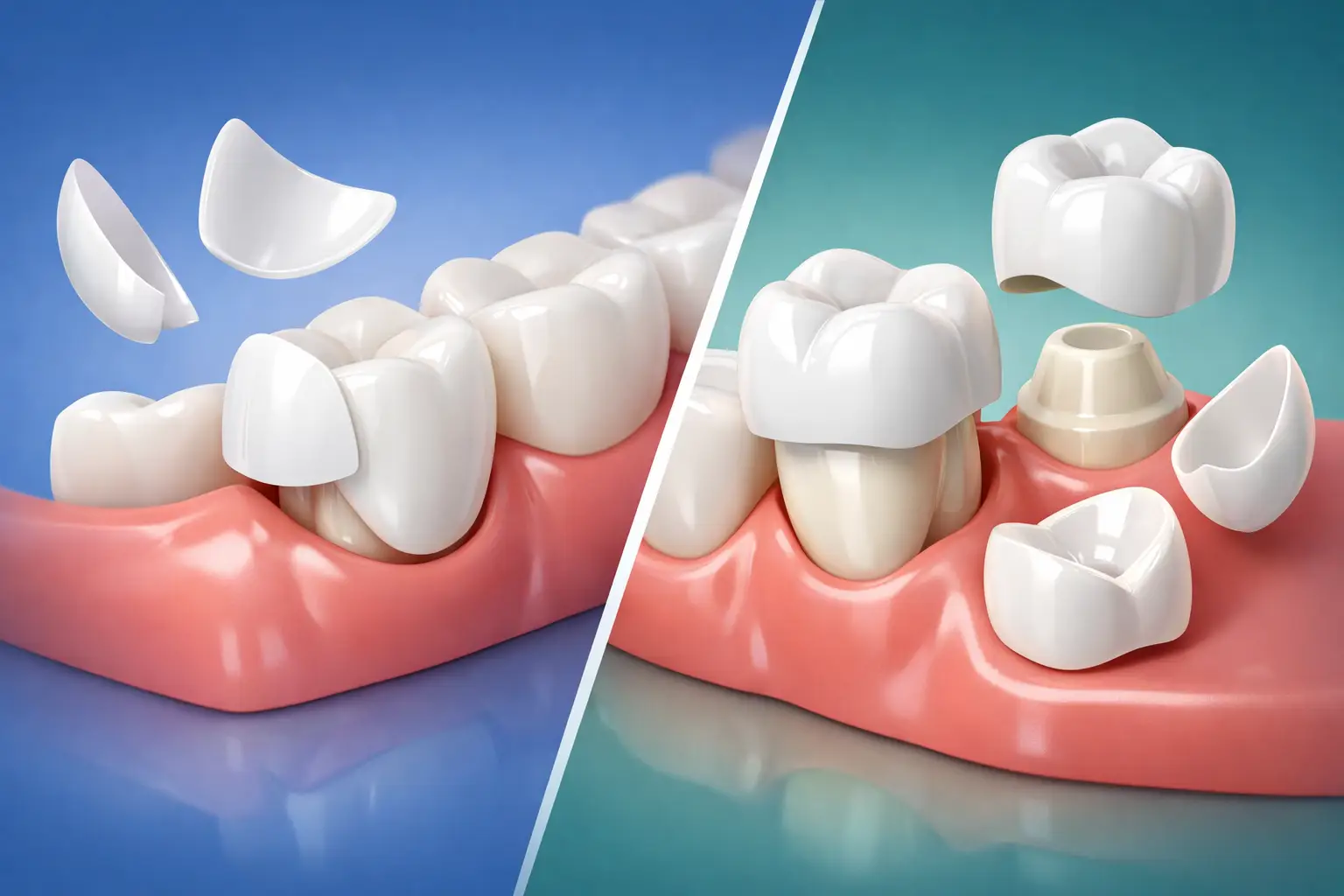
The simplest way to understand veneers vs crowns is to look at how much of the tooth each restoration covers. A veneer is a thin facing bonded to the front surface of the tooth, mainly to improve appearance. A crown covers the whole visible part of the tooth above the gum line, which means it can change the tooth’s shape, colour and strength more comprehensively.
Because of that, veneers are commonly used for cosmetic concerns such as worn edges, uneven shape, small gaps, discolouration that does not respond well to whitening, or minor alignment issues. Crowns are more often recommended when a tooth is heavily filled, cracked, root canal treated, structurally weak, or already damaged to the point that a veneer would not be reliable.
The difference is not just cosmetic versus functional. In many cases, both options improve appearance and both can be durable. The real question is whether the tooth needs surface enhancement or full coverage.
When veneers are usually the better option
Veneers tend to suit patients who want to improve the front teeth and still have enough strong natural enamel for bonding. If the tooth is healthy overall and the main issue is visible, a veneer can create a very refined result with less intervention than a crown.
This is why veneers are often chosen for smile design cases. They can correct shape, symmetry and shade while preserving more of the natural tooth. For patients who dislike chipped edges, short teeth, slight irregularities or stubborn staining, veneers can offer a very natural-looking improvement.
That said, veneers are not ideal for every smile. If someone has severe grinding, very large fillings, extensive decay, or significant structural loss, a veneer may not provide enough support. In those cases, choosing a veneer just because it sounds more conservative can lead to a weaker long-term result.
What veneers do well
Veneers are particularly effective when the goal is aesthetic precision. They allow careful control over contour, translucency and proportion, which is why they are popular in cosmetic dentistry. When planned properly with digital smile analysis and facial balance in mind, they can look highly natural rather than overly white or artificial.
They also usually require less reduction than full crowns, depending on the case. That matters to many patients, especially those who want to preserve as much natural tooth structure as possible.
When crowns make more sense
Crowns are often the stronger clinical choice when a tooth has already lost substantial structure. If a tooth has a large old filling, a fracture, advanced wear, or has been treated with root canal therapy, a crown can provide the coverage needed to protect it during biting and chewing.
This is especially relevant for back teeth, where forces are higher. Molars and premolars take much more pressure than front teeth, so a restoration in that area must be selected with function in mind, not appearance alone.
Crowns are also commonly used when a tooth needs more than cosmetic adjustment. If the bite needs correcting, the existing tooth shape is poor, or the tooth is too weakened for a bonded veneer, a crown offers greater stability.
What crowns do well
A crown can rebuild a tooth in a more complete way. It covers all visible surfaces, which means it can restore teeth that are badly damaged or heavily restored. It is often the safer option when the priority is long-term support.
Modern crowns can also be highly aesthetic. Materials such as zirconia and advanced ceramic allow crowns to look very natural, especially on visible teeth. So while crowns are more comprehensive, that does not mean they must look bulky or obvious.
Veneers vs crowns for appearance
If your main concern is smile aesthetics, veneers often have the advantage for front teeth that are otherwise healthy. They are designed with cosmetic detail in mind and can create a bright, balanced appearance with a conservative approach.
However, crowns can also produce excellent aesthetic results, particularly when the tooth underneath is compromised. A beautiful veneer on a weak tooth is not a better treatment just because it preserves more enamel. The final result has to be attractive and dependable.
For this reason, treatment planning should not start with the material. It should start with the condition of the teeth, the bite, gum levels, and the patient’s goals. In a well-planned case, the restoration type follows the diagnosis.
Veneers vs crowns for durability
Patients often ask which lasts longer. There is no universal winner because longevity depends heavily on case selection, bite forces, oral hygiene, and habits such as clenching or nail biting.
A well-made veneer on the right tooth can last many years. A well-made crown on a weakened tooth can also last many years. Problems usually happen when the wrong restoration is chosen for the clinical situation. For example, using veneers on teeth with major structural compromise may increase the risk of failure. Equally, placing crowns where veneers would have been sufficient may mean more reduction than necessary.
Durability also depends on maintenance. Regular reviews, good cleaning habits and, where needed, a night guard for grinding all help protect the investment.
How tooth preparation differs
One reason patients compare veneers and crowns so closely is the amount of preparation involved. In general, veneers require less reduction because they cover only the front surface and sometimes the edge of the tooth. Crowns usually involve more shaping because the restoration must fit around the entire visible tooth.
That does not automatically make veneers the better option. Minimal treatment is only beneficial if it still solves the problem properly. If a tooth needs full coverage, avoiding a crown can be a false economy.
A responsible dentist will look at how much healthy tooth remains and recommend the least invasive option that is still clinically sound.
Cost matters, but value matters more
Cost is a real part of the decision, especially for patients comparing treatment at home with options abroad. Veneers and crowns vary in price depending on material, complexity, the number of teeth involved, and whether additional treatment is needed first.
Veneers can be more cost-effective in smile makeover cases when the teeth are healthy and the work is mainly cosmetic. Crowns may involve a higher level of treatment because they often address damaged teeth with functional demands.
Still, the best value does not come from choosing the cheaper restoration on paper. It comes from selecting the treatment that fits the tooth properly, reduces the risk of complications and gives a stable result over time. For international patients, this is particularly important because predictable planning and follow-up support matter just as much as the initial fee.
Which option is right for you?
If your teeth are generally healthy but you want to improve shape, shade or minor imperfections, veneers may be the right path. If a tooth is cracked, heavily restored, worn down or structurally weak, a crown is often the more dependable solution.
Some patients need both. It is not unusual in full smile rehabilitation to use veneers on certain front teeth and crowns on others that require more support. Good dentistry is not about forcing every tooth into the same treatment category. It is about choosing the right restoration for each tooth while keeping the whole smile balanced.
At Dentaglobal, that decision is guided by clinical examination, digital planning and a clear discussion of what you want to achieve. For patients travelling to Turkey, that clarity is especially valuable because it helps avoid surprises and supports confident decision-making before treatment begins.
The best place to start is not by asking which treatment is better in general. It is by asking what your teeth need in order to look natural, function well and stay stable for years to come.