

All on 4 vs Dentures: What Changes Most?
10 April 2026Losing most or all of your teeth changes more than your smile. It affects how you eat, how clearly you speak, how confident you feel in social situations, and in many cases how much you think about your mouth every single day. When patients compare all on 4 vs dentures, they are usually not just choosing a treatment. They are choosing the kind of daily life they want to return to.
For some people, removable dentures remain a practical and budget-conscious solution. For others, All-on-4 offers a more fixed, stable, and natural-feeling result that can make full-mouth restoration feel far less like a compromise. The right choice depends on bone levels, health, budget, expectations, and how important long-term comfort is to you.
All on 4 vs dentures: the basic difference
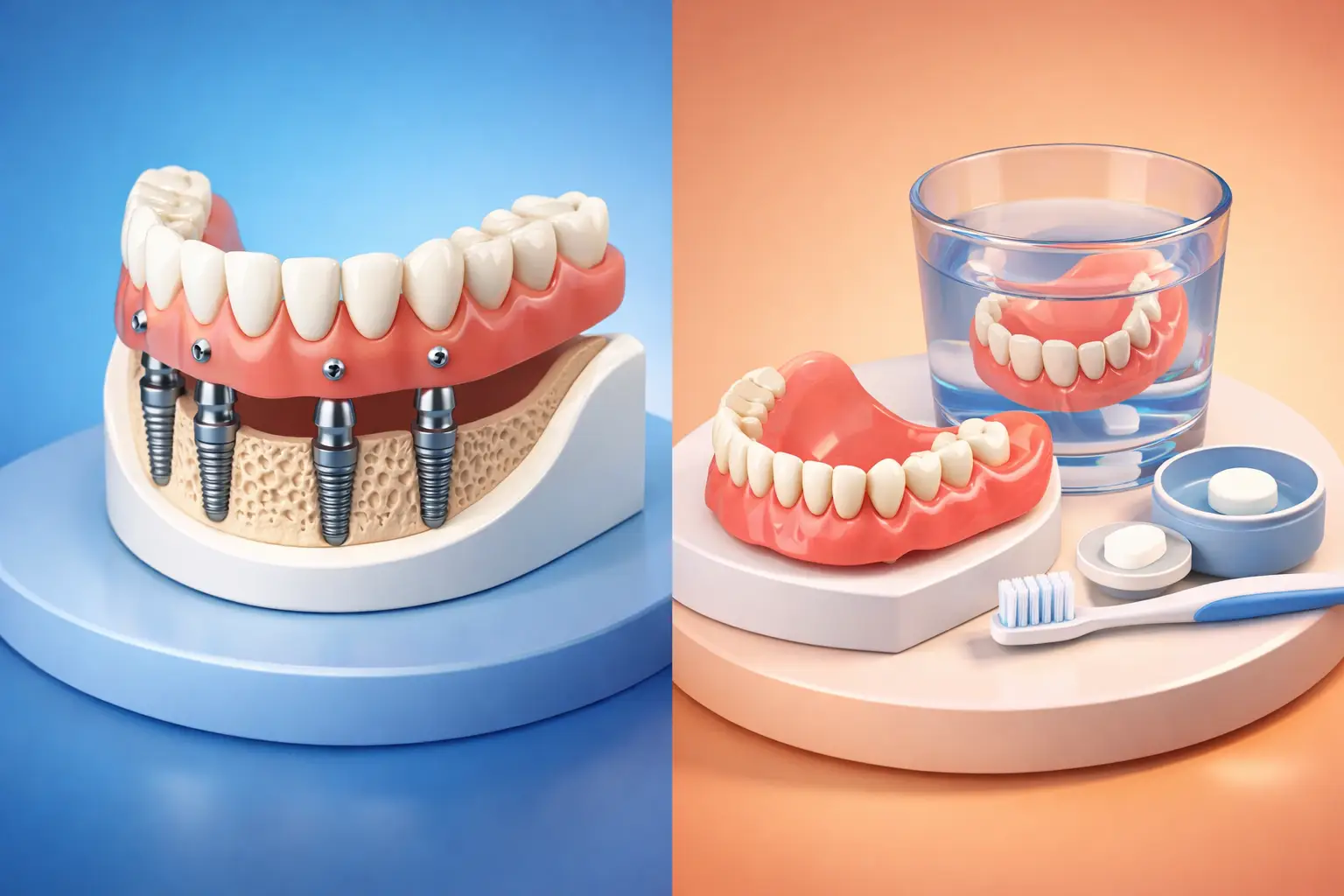
The main distinction is simple. Traditional dentures are removable prosthetic teeth that sit on the gums. All-on-4 is a fixed full-arch restoration supported by four dental implants placed in the jaw.
That difference affects almost everything else. Dentures rely on the shape of the gums and underlying bone for support. All-on-4 relies on implants integrated into the bone, which gives the restoration much greater stability. In practical terms, this means dentures can move, rub, or loosen over time, while All-on-4 is designed to stay firmly in place.
Patients often assume both options do the same job because both replace a full arch of missing teeth. Clinically and functionally, though, the experience is very different.
How dentures feel in everyday life
Dentures have helped many patients restore appearance and basic function, and modern dentures can look very natural. They can be especially suitable for people who want a non-surgical treatment or need a lower upfront cost.
However, dentures are not identical to natural teeth. Because they rest on soft tissue rather than being anchored into bone, some movement is common. That can make eating harder foods less predictable. Certain patients also notice clicking, slipping, sore spots, or a feeling of bulkiness in the mouth.
Upper dentures in particular often cover part of the palate, which can affect taste and sensation. Lower dentures can be more challenging because they tend to have less natural suction and may feel less secure during speaking or chewing.
This does not mean dentures are a poor treatment. It means expectations need to be realistic. For patients who can accept a removable solution and are comfortable with periodic adjustments, dentures can still be effective.
How All-on-4 changes function and stability
All-on-4 was developed to provide a full set of fixed teeth using a smaller number of implants, often avoiding the need for more extensive grafting in suitable cases. Two implants are usually placed at the front and two at an angle in the back to maximise available bone.
Because the bridge is attached to implants, it feels more secure than a removable denture. Most patients notice the difference quickly when eating, laughing, or speaking. There is less concern about the teeth shifting at the wrong moment, and the bite force is generally stronger than with conventional dentures.
Another important point is bone stimulation. Dental implants help transmit chewing forces to the jawbone, which can reduce the rate of bone loss. Dentures do not do this. Over time, ongoing bone resorption can change the fit of dentures and alter facial support.
For many patients, the biggest advantage is not only function but peace of mind. A fixed full-arch restoration can feel closer to having teeth again, rather than managing a removable appliance.
Comfort, confidence and speech
When choosing between all on 4 vs dentures, comfort is often more decisive than appearance. Both can be made to look attractive, but living with them day to day is where the real difference appears.
Dentures may require an adaptation period, and some patients never fully stop being aware that they are wearing them. Gum irritation, pressure points, and the need for adhesive are common frustrations. Speech can also need practice, especially in the early stages.
All-on-4 usually feels more natural because it is fixed in place. There is no need to remove it at night, and there is less chance of movement while talking. Patients who have felt embarrassed by loose dentures often see this as a major quality-of-life improvement.
That said, All-on-4 is still a dental treatment with an adjustment period. Mild tenderness after surgery, temporary dietary restrictions, and the need to protect healing implants are part of the process. It is not instant perfection, but for suitable candidates it often provides a much more stable long-term outcome.
Maintenance is different, not absent
Some patients think fixed teeth mean no maintenance. That is not the case. All-on-4 and dentures both require ongoing care, but the routine is different.
Dentures must be removed and cleaned daily. They may also need relining or replacement over time as the jaw changes shape. If they become loose, they can create sore areas and reduced chewing efficiency.
All-on-4 stays in the mouth, so cleaning involves brushing and using the right hygiene tools around the bridge and gumline. Regular professional reviews are essential to monitor the implants, soft tissues, and bite. The restoration itself may also need maintenance over the years, depending on wear and the material used.
In other words, All-on-4 is lower on inconvenience for many patients, but it still needs commitment. Good home care and follow-up appointments are part of protecting the result.
Cost now versus value over time
Cost is one of the biggest reasons patients hesitate. Dentures usually have a lower initial fee, which makes them more accessible in the short term. If budget is the main deciding factor, this can be a sensible starting point.
All-on-4 generally costs more because it includes surgery, implants, advanced planning, and a fixed prosthesis. Digital diagnostics, surgical precision, and specialist-led treatment all contribute to that investment.
The more useful question is not just what costs less today, but what delivers better value for your circumstances. Dentures may need more adjustments, relines, replacements, and adaptation over time. All-on-4 often carries a higher upfront cost but may provide stronger function, better confidence, and more predictable long-term comfort.
For international patients, this is one reason many consider treatment abroad. Clinics such as Dentaglobal can provide advanced implant solutions with modern technology and structured patient support, often at a significantly more accessible price than in the UK or Western Europe.
Who is a better candidate for dentures?
Dentures may suit patients who want to avoid surgery, have medical factors that limit implant treatment, or need the most affordable option available. They can also work well as an interim solution while a broader treatment plan is being considered.
In some cases, severe bone loss, untreated health issues, or personal preference may make removable teeth the better choice for now. There is no value in forcing an implant solution if the clinical situation or the patient's priorities do not support it.
A good clinician should explain this clearly. The best treatment is not always the most advanced one. It is the one that fits your oral health, expectations, and long-term plan.
Who is a better candidate for All-on-4?
All-on-4 is often ideal for patients with multiple failing teeth or complete tooth loss who want a fixed alternative to dentures. It can be especially appealing if you are tired of loose plates, adhesives, or avoiding certain foods.
It may also be suitable for patients who have some bone loss but still have enough available bone for strategic implant placement. Thorough assessment is essential here. Digital scans, bite evaluation, gum health checks, and medical history all help determine whether the treatment is safe and predictable.
Smoking, uncontrolled diabetes, active gum disease, and poor oral hygiene do not always rule treatment out, but they can affect success and need to be managed carefully.
Questions worth asking before you decide
If you are comparing options, focus on the practical realities. Ask how stable the teeth will feel, what maintenance is involved, how long treatment takes, what happens if bone loss is present, and what kind of aftercare is available once you return home if you are travelling.
You should also ask what the temporary phase looks like. With All-on-4, many patients receive provisional teeth while healing takes place, but timelines vary. With dentures, it is worth understanding how many fittings and future adjustments may be needed.
Clear planning matters just as much as the treatment itself. A trustworthy clinic should make the process understandable, not vague.
The real decision behind all on 4 vs dentures
This choice often comes down to what level of function and confidence you want to restore. If your goal is the most economical route to replacing missing teeth, dentures can still serve a purpose. If your goal is a fixed solution that feels more secure and helps you get closer to normal eating, speaking, and smiling, All-on-4 is often the stronger option.
Neither treatment is right for everyone. The smartest next step is a proper clinical assessment with honest guidance based on your mouth, your priorities, and your budget. When the plan is built around those three things, the decision tends to become much clearer.
If you have spent too long adapting your life around missing teeth, this is the point to stop settling for uncertainty and start asking what would actually feel right every day.